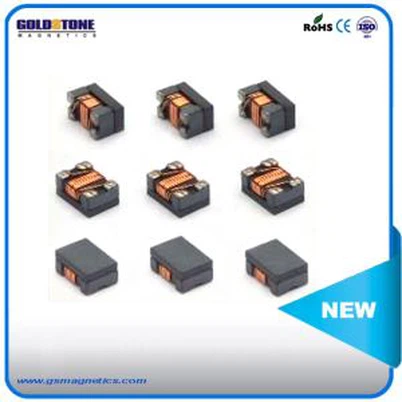


Inductance Coil
Leave a message
The inductance coil is made up of the conductors which are wound on the insulated tube one by one, and the conductors are insulated from each other. The insulated tube can be hollow, or it can contain iron core or magnetic powder core. In L, there are Henry (H), milli Henry (mH), Wahenry (uH), 1H=10^3mH=10^6uH.

Inductors are devices that operate on the principle of electromagnetic induction. When an electric current flows through a wire, a certain electromagnetic field will be generated around the wire, and the conductor of the electromagnetic field itself will be in the electromagnetic field within the wire induction. The effect on the conductor itself that produces the electromagnetic field is called "self-inductance", i.e. the variable current produced by the conductor itself produces a variable magnetic field, which further affects the current in the conductor; the effect on other conductors in this electromagnetic field is called "mutual inductance".
The electrical characteristics of the inductance coil are opposite to that of the capacitor, and "low frequency, high impedance". High-frequency signals will encounter great resistance when passing through the inductor coil, and it is difficult to pass through; while low-frequency signals will show less resistance when passing through it, that is, low-frequency signals can pass through it more easily. The inductance coil has almost zero resistance to direct current.
Resistance, capacitance, and inductance all present a certain resistance to the flow of electrical signals in the circuit, which we call impedance. The impedance of the inductor to the current signal is made use of the self inductance of the coil. Inductors sometimes call it "inductor" or "coil", which is represented by the letter "L". When winding the inductance coil, the number of turns around the coil is commonly referred to as the "turn number" of the coil.