

Difference Between EI Type High Frequency Transformer And EE Type Transformer
Leave a message
Here, we don't need to involve too many problems about the magnetic core material itself and manufacturing. The key is to see the differences in application details. After all, we are an application project.
Some netizens may think that as long as the material, volume and other parameters of the two are the same, the processing power capacity should be interchangeable. However, this is not the case. Their organizations decide that their performance in EMC is different.
Let's first take a look at the structure of the flyback transformer with EE core (to save time, we can use the drawing to scribble on it, so we can make do with it):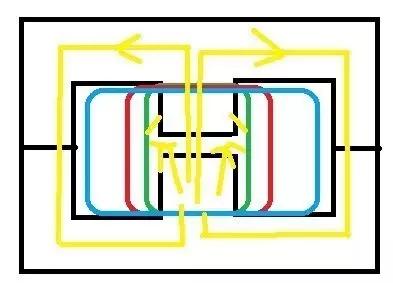
As we all know, the Flyback topology transformer needs to open an air gap in the middle column, as shown in the figure above. After the air gap of the magnetic core is opened, it is obvious that the edge leakage flux will increase, assuming that the magnetic flux is shown in yellow. Anyone who has worked with EMC should know the power of magnetic flux leakage, so there is no need to talk about it here.
However, the EE core has natural advantages, because its air gap is in the middle of the central
column, and the outer layer of the air gap has a thick winding shield. Due to the shielding effect of the winding itself, the possibility of leakage flux radiation to the external space is greatly reduced.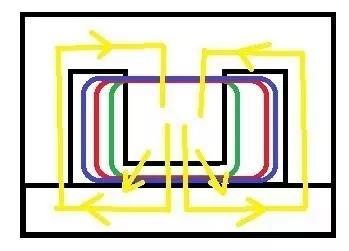
As shown in the figure above, the air gap of EI magnetic core should be loaded at the contact position between sheet E and sheet I. That is, the air gap is located at the edge. In this way, the shielding effect of the winding itself will be greatly reduced, or even powerless.
From the two figures, the performance of these two structures in EMC is self-evident.
Any question and inquiry please contact :sales@gsmagnrtics.com
WeChat:gungualiuyuan