

Application Of Electronic Components in UAV
Leave a message
Recently, unmanned aerial vehicle (UAV) technology, which is mainly used in military applications, has begun to expand its application to the public or private sector due to its technological progress. Due to its operational advantages in reliability, mobility and cost-effectiveness, unmanned aerial vehicles have unlimited potential.

The application of photography or video camera brings it the feasibility of rapid growth, and there have been emerging applications in the fields of traffic monitoring, express service, forest fire monitoring and monitoring dangerous areas or ecosystems. However, one of the challenging problems remains to be solved, because most UAVs are limited by the capacity and weight of batteries.
Wireless power transmission (WPT) will be an alternative technology to deal with the problem of power required by unmanned aerial vehicles. It can make UAV increase its flight range and operation time, and will promote autonomous flight. Over the years, inductive WPT has been successfully applied to various electric vehicles, including the wireless electric bus developed in our early stage. The inductive WPT system is usually composed of transmitting coil (TX coil) and receiving coil (Rx coil), and the TX coil of our electric bus is arranged as a segmented loop under the road surface of the whole bus line.
The principle of inductive WPT is based on Faraday's law, in which alternating current (AC) in TX coil generates a time-varying magnetic field. The time-varying magnetic field from the TX coil is coupled to the RX coil through air, thereby generating a time-varying current in the RX coil through the coupled magnetic field. The output voltage is then generated at the RX coil terminal, where the specified DC voltage can be converted from the AC voltage at the RX coil.
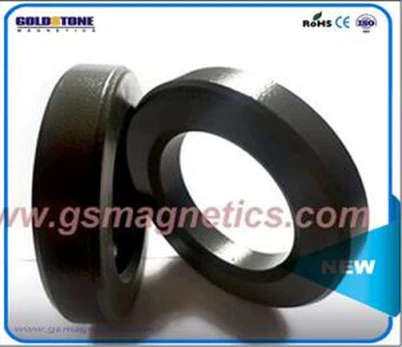
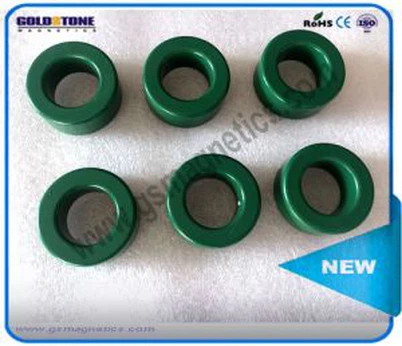
The principle of inductive WPT is very clear, and it has been successfully applied to our electric bus as the main power supply using custom TX RX structure. Based on the same principle of Faraday's law, WPT can also be applied to unmanned aerial vehicles. Ferrite is used in the practical scheme of inductive WPT system to improve magnetic coupling. Ferrites are known to have excellent high-frequency permeability and suitable electrical properties such as conductivity.
Although in general, ferrite is an optimized device for conducting the magnetic field with the required efficiency, ferrite is not very practical in the WPT of UAV. In the extreme dynamic environment of UAV operation, the brittleness of ferrite hinders the application of WPT. There are several works that can improve the performance of UAV, but due to the limited practical characteristics, it can not be used as a high-efficiency ferrite magnetic material for WPT. The soft magnetic composite material in this paper can replace ferrite, and the purpose is to integrate the inductive WPT system into UAV.
This paper studies the application of different ferromagnetic materials in the magnetic core of UAV WPT system. This comparative study is based on the newly developed soft magnetic composite (SMC) and conventional ferrite used as the core of WPT system. In particular, we mainly discuss how to select the appropriate ferromagnetic core material for the UAV WPT system by considering the harsh environment.
The interconnection products provided by Shaanxi Gold-Stone electronics are easy to assemble and can maintain high reliability in the worst environment.
In addition, as the size of electronic products continues to shrink, te provides various flat and narrow body versions of connectors with various temperatures and fire resistance levels, which are suitable for any UAV application.