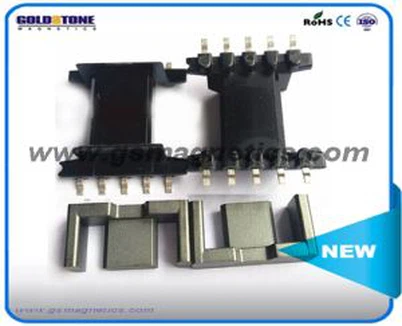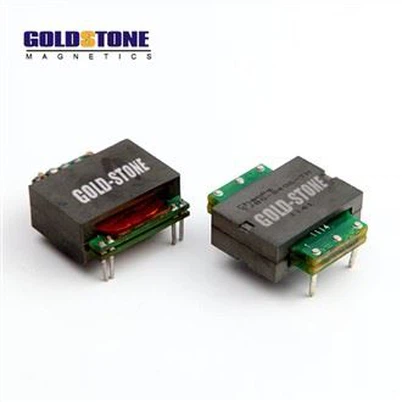


What plastic is the electronic transformer skeleton made of?
Leave a message
What plastic is the skeleton of the electronic transformer made of?
① Nylon (NYLON): white and transparent, with a certain degree of water absorption, strong oil resistance, toughness, good ductility, not fragile, but easy to melt when heated, easy to deform, temperature resistance is usually about 110 degrees, fire rating is 94V-2 or 94V-HB, voltage resistance is 27KV/mm, and its surface is smooth; Due to the above characteristics, nylon materials are usually used to make low-frequency transformers with low winding requirements or common coil inductors
② PBT: generally white, brown or beige, relatively good toughness, temperature resistance of about 120 degrees, easy to deform after being heated (thermal deformation temperature of 205 degrees), fire rating of 94V-0, excellent insulation performance, voltage resistance of 22KV/mm, and unsmooth surface; Due to the above characteristics, this material is mainly used to make small and medium-sized transformers or inductors with relatively small wire diameters. At the same time, this material is cheap, easy to purchase, and low in manufacturing cost, which is suitable for mass production.
③ PET: generally black, easy to melt when heated, general toughness (slightly better than nylon), easy to form, temperature resistance of about 130 degrees, difficult to deform when heated (thermal deformation temperature of 246 degrees), fire rating of 94V-0, insulation performance of this material is slightly worse than PBT, voltage resistance of 18kV/mm, its surface is not smooth, and it can be used as high-frequency transformer framework, inductance shell, etc., with a price slightly higher than PBT.
④ LCP: generally beige, is a kind of liquid crystal polymer, which is between PET and bakelite. It has good hardness and toughness. Typical materials, such as E-4008, have a thermal deformation temperature of 313 degrees. It still has good dimensional stability, creep resistance, extremely low thermal expansion coefficient and extremely high dielectric properties at high temperatures. It is mostly used to make SMD transformers in the field of transformers, with a flame-retardant rating of 94V-0, But it is expensive.
⑤ PHENOLIC: generally black, it is the most commonly used high-quality raw material for transformer framework, such as Changchun T373J, T375J, Sumitomo PM9820, PM9630, etc. It is brittle and fragile, with a fire rating of 94V-0, particularly resistant to high temperature (370 ° C), voltage resistance of 10KV/mm, and smooth surface; It can be said that bakelite is one of the most widely used materials in transformers. Because it has high temperature resistance, no deformation, and medium voltage resistance, it is suitable for large and medium-sized power transformers, but it is fragile, which is inevitable, and such materials cannot be recycled and reused.
The high-frequency transformer is generally made of bakelite, which has good temperature resistance, is not easy to deform and has luster. Compared with plastic high-frequency transformer, the only disadvantage is that it is easy to break.
However, high-frequency transformers made of PET and PBT are rarely heard of or seen among peers. What are the two materials? What's the difference between it and the bakelite skeleton?
PET is made of polyethylene terephthalate. PET is a milky white or light yellow highly crystalline polymer with smooth and shiny surface. It has excellent physical and mechanical properties in a wide temperature range. Its long-term use temperature can reach 120 ℃, and its electrical insulation is excellent. Even under high temperature and high frequency, its electrical performance is still good, but its corona resistance is poor, creep resistance, fatigue resistance, friction resistance, and dimensional stability are good.
PBT is one of the five major engineering plastics, polybutylene terephthalate (PBT), its English name is polybutylene terephthalate (PBT for short). It is a thermoplastic polyester. Compared with other thermoplastic engineering plastics, the non reinforced PBT has better processing properties and electrical properties. It can be used as the return transformer of TV, automobile distributor and ignition coil, office equipment shell and base, various automobile exterior parts, air conditioner fan, electronic stove base, office equipment shell
1) The most commonly used is nylon PA66, which is usually filled with some glass fibers and has a temperature resistance of 130 degrees
2) PET plastic, temperature resistance 155 ℃
3) The temperature resistance of epoxy board assembly is 130 ° C, 155 ° C and 180 ° C, mainly related to the impregnated insulating paint
4) Glass fiber brace assembly, temperature resistance 180 °
5) There are many kinds of insulating paper, such as fast paper, highland barley paper, DMD, NMN, Nomex
6) Other engineering plastics, PBT, bakelite, PTFE, etc
Any datasheet you need,please check the
https://www.gsmagnetics.com/dip-bobbin-pdf
https://www.gsmagnetics.com/smd-bobbin-pdf
if u have the business, pelase send us the mail
China Office: NO.21 Dongyi Road .Xi'an Shaanxi P.R.China. TEL: 86-29-85401274 FAX: 86-29-85401274 Email: sales@gsmagnetics.com sales@gstronics.com Web:www.gsmagnetics.com Contact Person: Mr Mark Chen(General Manager) Skype: Mark.chen90 Whatsapp:+8615353513263 Contact Person: Helen.Liu Email:Helen.Liu@gsmagnetics.com Skype:Helen.Liu@gsmagnetics.com QQ: 245939971 Wechat:gungualiuyuanzy |