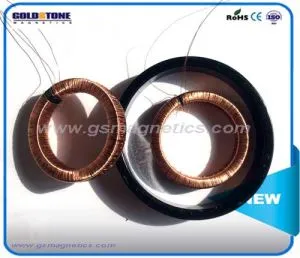


Amorphous magnetic ring
Leave a message
Amorphous magnetic ring
It is a magnetic component processed with amorphous materials. According to the material of the amorphous strip used
Similarly, it can be divided into iron based amorphous, cobalt based amorphous, and so on.
According to the shape of the material, it can be divided into strip type magnetic rings and powder type magnetic rings.
Amorphous magnetic ring, or metallic glass, is a new material that came out in the 1970s. It is the use of quenching technology to form molten steel into a thin strip with a thickness of 30 microns. The solid alloy (thin strip) obtained is different from the crystal structure in which atoms are arranged regularly in cold-rolled silicon steel materials. It is this alloy whose atoms are in an irregular amorphous solid structure, making it have a narrow B-H circuit, high magnetic conductivity and low loss characteristics; At the same time, the irregular arrangement of atoms in amorphous alloys limits the free passage of electrons, resulting in a resistivity 2-3 times higher than that of crystalline alloys, which also helps to reduce eddy current losses. The transformer core made of amorphous alloy as raw material reduces its no-load loss by about 75% compared to traditional transformers using silicon steel sheets, making amorphous alloy transformers have significant energy-saving and environmental protection effects. When amorphous alloy transformer core is used for oil-immersed transformers, it can significantly reduce various harmful gases. Therefore, more and more amorphous alloys are being used as raw materials for transformer cores.

Performance characteristics:. High saturation magnetic induction intensity, the saturation magnetic induction of iron based nanocrystalline alloys is three times that of ferrite, and the output power of iron cores with the same volume is twice that of ferrite bowls. At the same time, it has greater overload resistance. High permeability, low coercivity - improves transformer efficiency, reduces excitation power, and reduces copper loss. The permeability is more than 10 times that of ferrite. Low loss - reduces the temperature rise of the transformer, and its core loss in the frequency range of 20KHZ-50KHZ is 1/2-1/5 of the ferrite loss. Excellent temperature stability - can operate between -55-130 ° C

Recently, we have designed EMI and | EMC new products. Welcome to consult